

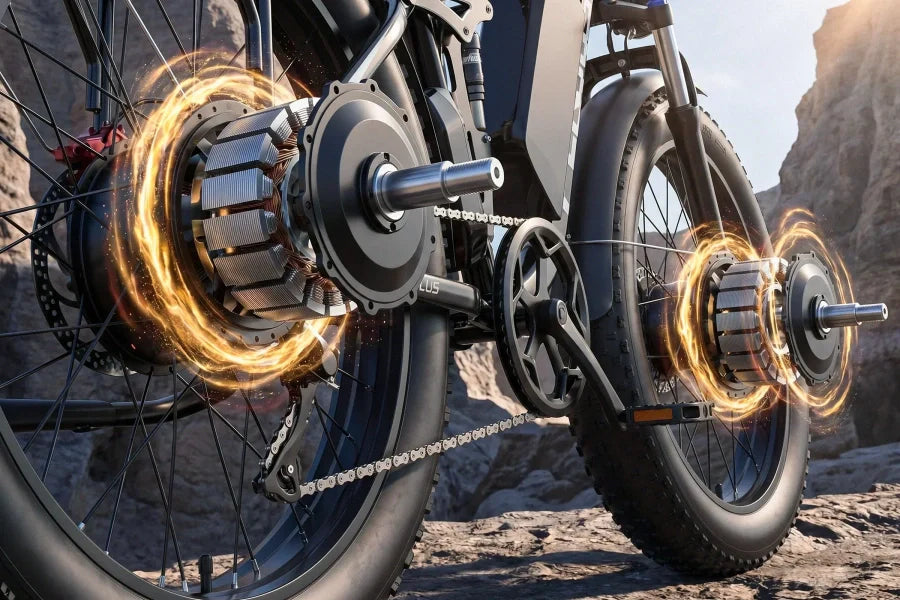
In the high-stakes world of off-road electromobility, the debate between motor architectures often overlooks a fundamental engineering truth: simplicity is the ultimate sophistication. For the modern explorer, an electric bike hub motor offers a level of mechanical resilience and drivetrain independence that mid-drive systems struggle to replicate. At Fengqs, we have strategically engineered our entire fleet around this philosophy, ensuring that power is delivered directly where it’s needed most—the wheel.

The internal planetary gear structure of a high-torque geared hub motor.
1. The Mechanics of Direct Propulsion
A electric bike hub motor operates by converting electrical energy into torque directly within the wheel hub. This eliminates the need for power to travel through the chain, derailleurs, and cassettes. By minimizing the "mechanical path," we reduce energy loss through friction. In off-road scenarios, this direct torque delivery provides an instantaneous response, allowing riders to clear obstacles with precision timing.
2. Independence from the Drivetrain: Wear and Tear Reduction
Perhaps the most significant advantage of hub-driven technology is its separation from the bicycle’s pedal drivetrain. In traditional mid-drive systems, the motor’s torque is added to the rider's force, putting immense stress on the chain. This often leads to "chain stretch" or premature derailleur failure. Because Fengqs e-bikes utilize hub motors, the chain only handles the rider's pedaling force, drastically extending the service life of consumable components.
3. Redundancy and the Dual-Motor Revolution
For extreme off-roading, a single motor may face thermal limits. This is where the hub motor's modularity shines. By placing a motor in both the front and rear hubs, we create an All-Wheel Drive (AWD) system. This provides electrical redundancy; if one motor system encounters a sensor fault, the other remains fully operational, ensuring you are never stranded in the backcountry.
4. Implementation Across the Fengqs Lineup
Our commitment to hub motor technology is evident across our specialized fleet. Each model leverages these benefits to suit specific rider profiles:
| Model Series | Core Application | Technical Edge |
|---|---|---|
| Q8 PLUS 24-Inch | Compact Off-Road | High torque density in a agile 24" Tire. |
| Q8 PLUS 26-Inch | Extreme AWD Terrain | AWD Hub synergy for ultimate hill climbing. |
| Q8 Mountain | Versatile Commute | Efficient geared hub for smooth road-to-trail transitions. |
| H6 PRO | Peak Performance | 3000W output via dual high-speed hub motors. |
| H2 PRO | Heavy-Duty Utility | Robust load-bearing hub with heat-dissipating alloy casing. |
5. Reliability Metrics and Maintenance Cycles
From an engineering lifecycle perspective, the electric bike hub motor is a "fit and forget" component. High-quality geared hubs, like those found in the H2 PRO, are sealed against IPX6 environmental factors. Without external moving parts (gears/chains) involved in the motor's internal propulsion, the failure rate is significantly lower than mid-drive alternatives.
Technical FAQ
A: Modern Fengqs designs use quick-disconnect waterproof cables. While it adds one extra step compared to a standard bike, the process is straightforward for anyone with basic tools.
A: Absolutely. By utilizing internal planetary gearing, hub motors can generate massive torque, making them excellent climbers.
A: Yes, this is a specialty of our lineup. Models like the Q8 PLUS 26 Dual Motor use this configuration for All-Wheel Drive, providing unmatched traction in mud and sand.
Share:
What Is the Fastest Ebike You Can Get Under $1000?
What Are Personalized Father's Day Gifts? Complete Guide to Meaning, Ideas, and How to Choose the Right One in 2026