

Commuting · Electric Bikes · Buyer's Guide
The Best eBike for Commuting:
What Nobody Tells You
How electric bikes are quietly winning the commute war — and what to look for before you buy one.
The Commuting Problem Nobody Wants to Admit
The average American commuter spends 54 hours a year stuck in traffic. That's more than an entire work week — gone. Not resting, not working, not enjoying life. Just sitting behind a steering wheel, watching the same brake lights blink on and off.
And that's before you factor in what it costs.
Gas. Insurance. Parking. Wear and tear. The occasional $400 diagnostic fee just to hear a mechanic say "it's the sensor." According to AAA, the average American spends over $10,700 per year to own and operate a car. Most of that cost is baked into the commute.
Now here's the part that doesn't get said enough:
For millions of daily commuters — especially those traveling 10 to 30 miles per day — a high-quality electric bike isn't a compromise. It's an upgrade. Faster door-to-door times in urban areas. No parking anxiety. No fuel receipts. And, increasingly, no sitting still when you could be moving.
The commuting problem isn't really about the car. It's about what we keep choosing instead of something better.
Why eBikes Are Rewriting the Rules of Urban Commuting
Electric bikes have quietly crossed a threshold. They're no longer a novelty for weekend riders or fitness enthusiasts. They are, in growing numbers of cities worldwide, the most practical, most affordable, and most enjoyable way to get from A to B.
"E-bikes are the best thing to happen to cities in decades."
— Micah Toll, Electric Vehicle Journalist & Author of The Ultimate DIY Ebike GuideToll's observation isn't hyperbole. It reflects what urban planners, transit researchers, and hundreds of thousands of daily riders are discovering firsthand: an eBike doesn't just get you to work — it changes how you think about distance, time, and cost.
Here's what's shifted in the last few years:
🔋 Battery Technology Has Matured
Modern commuter eBikes routinely offer ranges of 40 to 80+ miles per charge. That covers the vast majority of urban and suburban commutes on a single battery. You charge overnight, you ride all day. No range anxiety. No midday pit stops.
⚡ Motors Are Genuinely Powerful Now
Early eBikes struggled on hills. Today's best commuter models pack motors with peak outputs of 1,000W to 2,000W — enough to climb steep grades without breaking a sweat, maintain speed in headwinds, and keep up with urban traffic flows without feeling underpowered.
🌍 Cities Are Finally Catching Up
Protected bike lanes, eBike subsidies, and workplace charging infrastructure are expanding in most major U.S. and European cities. The commuting ecosystem for eBike riders has never been more supportive — and it's still growing.
The Real Math: Car vs. eBike Commuting Costs
Numbers cut through a lot of noise. So let's do the math on a typical urban commuter — someone who drives 15 miles each way, five days a week.
| Expense Category | Car (Annual) | eBike (Annual) |
|---|---|---|
| Fuel / Charging | $2,200 – $3,000 | $30 – $60 |
| Insurance | $1,400 – $2,000 | $100 – $200 |
| Parking | $600 – $3,600 | $0 – $60 |
| Maintenance & Repairs | $1,200 – $2,000 | $100 – $250 |
| Depreciation | $3,000 – $5,000 | $100 – $300 |
| Annual Total | $8,400 – $15,600 | $330 – $870 |
The gap is staggering. Even at the high end, an eBike commuter spends less in a full year than a car commuter spends on fuel alone in four months.
And if your commuter eBike costs $899? You've broken even on the purchase price — compared to just a month or two of typical car commuting costs — before the calendar flips to February.
💡 The Overlooked Dividend
eBike commuters also gain back time. Bypassing gridlock, skipping parking lots, and riding directly to entrances means many urban commuters actually arrive faster by eBike than by car — with no stress and a natural energy boost from the ride itself.
What Makes the Best eBike for Commuting
Not all eBikes are built for commuting. A cruiser optimized for flat beach paths won't serve you well on a hilly city route. A pure mountain eBike might be overkill for smooth asphalt. Choosing the best eBike for your commute means matching the bike's core specs to the specific demands of your daily route.
Here's what to prioritize — ranked by real-world commuter importance:
1. Motor Power: Don't Underestimate Your Terrain
A 250W hub motor is fine on pancake-flat routes. But the moment you add a meaningful incline, cargo weight, or headwind — or simply want to keep up with urban traffic — you'll wish you had more power. For versatile commuting, look for at least 750W continuous / 1,500W+ peak. Motors in this range handle hills confidently and give you true speed flexibility without constant pedaling effort.
2. Battery Range: Match Your Commute, Not the Marketing
Manufacturers often list "maximum range" under ideal conditions: lightweight rider, flat terrain, low assist level, perfect temperature. Your real-world range will likely be 20–30% lower. A bike marketed at 60–85 miles of range gives you practical confidence for commutes up to 35–40 miles each way. If your commute is under 20 miles round-trip, almost any modern eBike will cover it. Beyond 30 miles round-trip, prioritize range above nearly everything else.
3. Top Speed: The Commute Rhythm Factor
In most U.S. states, Class 2 and Class 3 eBikes are limited to 20 or 28 mph with pedal assist. A bike capable of 28–32 mph keeps you flowing with urban traffic, reduces time spent blocking lanes, and makes longer commutes genuinely time-competitive with driving. Speed matters less in stop-and-go city cores; it matters significantly on arterials and mixed roads.
4. Terrain Handling: More Important Than It Looks
Even "flat" city commutes involve curb cuts, rough asphalt, occasional gravel paths, and unexpected obstacles. A bike with front suspension and wider tires (2.0"–2.4") absorbs these without bouncing you around or destroying your concentration. If your route includes dedicated trails, unpaved paths, or significant hills, look for a model with genuine off-road capability — not just the appearance of it.
5. Price-to-Value: The Real Commuter Calculus
Premium commuter eBikes can cost $3,000–$7,000. And yes, some of that spend buys genuine quality. But for most commuters, the $700–$1,200 category now delivers an extraordinary amount of real-world capability. The question isn't "is the expensive bike better?" — it's "does the extra cost improve my commute enough to justify it?" For most riders, it doesn't.
✅ Quick Commuter Checklist
Motor: 750W+ continuous · Range: covers 2× your round trip · Speed: 28 mph capable · Tires: 2.0"+ width · Price: under $1,000 for most commuters
7 Practical Tips for eBike Commuters
Choosing the right bike is half the equation. The other half is riding it well, maintaining it simply, and building habits that make every commute smoother than the last.
-
Plan your route before your first ride
Apps like Komoot, Google Maps (bike mode), and Strava's cycling routes show protected lanes, elevation changes, and surface conditions. A 5-minute pre-ride planning session can cut commute time and frustration significantly. Your first week on a new route is reconnaissance — treat it as such.
-
Charge to 80% for daily commuting
Lithium batteries live longer when you avoid constant 100% charges. If your bike easily covers your commute on 80% charge, make that your daily habit. Reserve full charges for longer weekend rides. This simple practice can meaningfully extend your battery's lifespan over years of use.
-
Use assist levels strategically, not maximally
Most riders default to the highest assist setting and burn through battery faster than necessary. Learn your route's terrain and drop to a lower assist level on flat sections. Save high assist for hills and headwinds. You'll arrive just as quickly, use far less power, and get a better cardiovascular workout in the process.
-
Invest in a quality lock — immediately
eBike theft is rising in pace with eBike adoption. A $50 cable lock won't protect an $899 investment. Use a U-lock as your primary security and a secondary cable to secure the wheel. Lock to fixed, immovable infrastructure. If possible, bring the bike inside at work. Your insurance premium is often cheaper than you'd expect for eBike coverage.
-
Dress for the destination, not the departure
Unlike traditional cycling, eBikes keep your exertion moderate even at speed. You likely won't arrive sweaty unless it's very hot or you're using low assist. Dress for your office, not for a workout — and pack a light jacket for cooler mornings. Weather-adaptive commuting on an eBike is far easier than most new riders expect.
-
Check tires and brakes weekly — it takes 90 seconds
Proper tire pressure (check the sidewall for recommended PSI) improves both range and ride quality. Grab the front and rear brake levers before each week begins: they should feel firm, not spongy or loose. If pads are thin or you hear grinding, replace them before you need them in an emergency. Two quick checks, 90 seconds, massively safer commute.
-
Tell people about it
This sounds trivial. It isn't. eBike commuting spreads through social proof. When colleagues see you arrive relaxed, on time, and without a parking receipt, they start asking questions. Within a year, parking lots with a few eBikes in them tend to become parking lots with a lot more. You might be the person who starts that at your workplace.
⚡ Commuter's Pick · Under $900
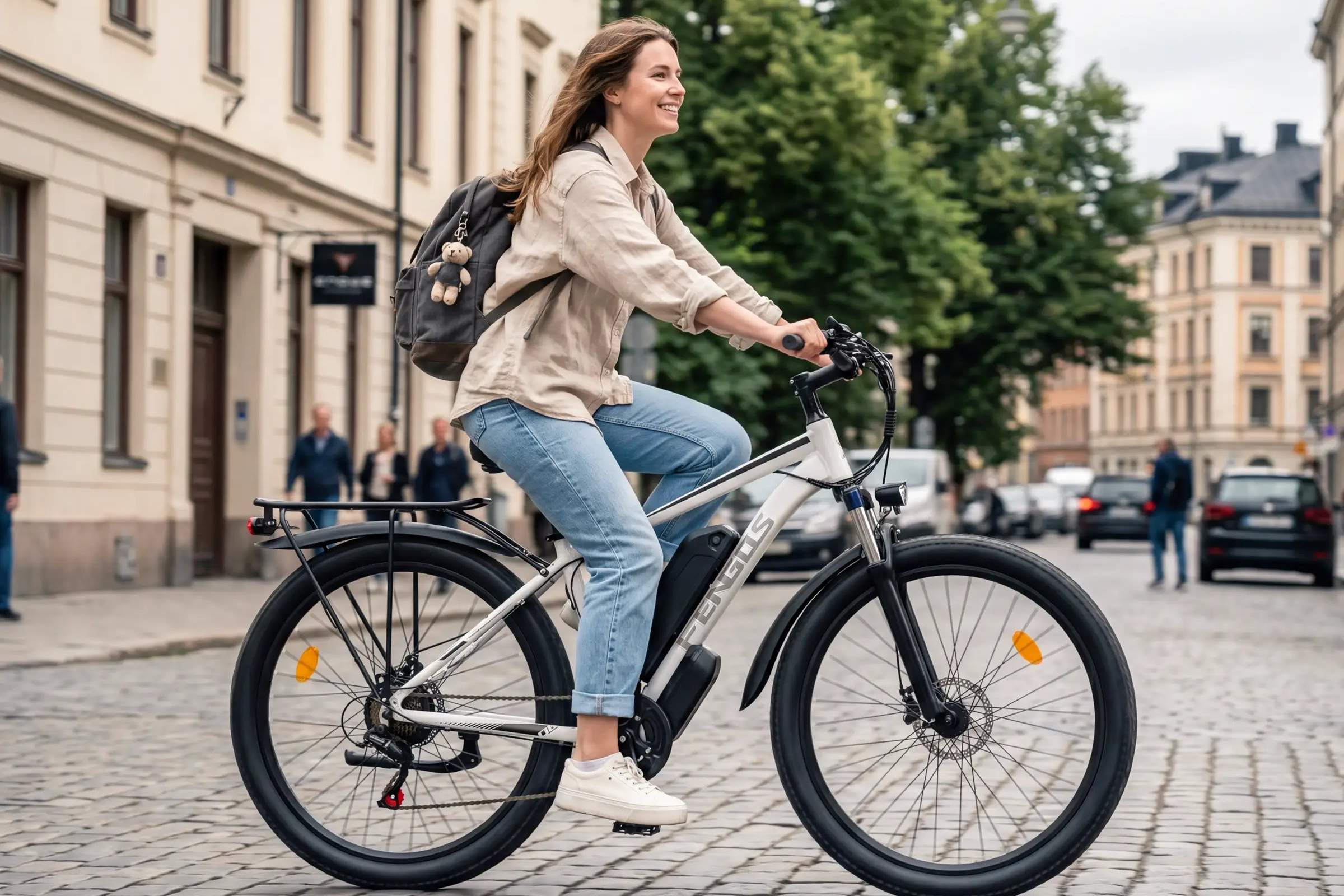
Meet the FENGQS Q8:
Built for Commuters Who Want More
Most commuter eBikes ask you to choose between power and price. The Q8 refuses to make that compromise.

Everything we covered in this guide — power, range, terrain capability, and value — the FENGQS Q8 delivers on every point. And it does it for $899. Less than most people spend on car insurance in two months.
What sets the Q8 apart from conventional commuter eBikes isn't just the specs — it's the category. This is a mountain-capable electric bike that happens to be an exceptional daily commuter. That matters for one simple reason: real commutes aren't always smooth. Hills happen. Wet roads happen. Detours through unfinished paths happen. A bike built for mountain terrain handles your commute with ease, not strain.
The 2,000W peak motor doesn't just handle hills — it dismisses them. At 35° maximum climb grade, you can ride gradients that would stop most commuter eBikes in their tracks. And at 60–85 miles of range, you're looking at a bike that handles a week of suburban commuting on a single weekend charge for many riders.
- 2,000W peak motor — handles any incline your commute throws at you
- 60–85 miles of range — covers most suburban round-trips with ease
- 32 mph top speed — keeps pace with urban traffic flows
- 35° max climb — genuine mountain-grade capability, not marketing copy
- Mountain bike geometry — absorbs road imperfections without jolting your commute
- Sports-athletic character — doubles as a weekend trail bike when the commute ends
- Under $900 — the best price-to-power ratio in its class
Ordinary commuter eBikes give you a quiet, polite ride that gets the job done. The FENGQS Q8 gives you a quiet, polite ride that gets the job done — and then, on Saturday morning, becomes the most exciting thing in your garage.
FAQ: Best eBike for Commuting
What is the best eBike for commuting in 2025?
The best commuter eBike balances motor power (750W–2,000W peak), real-world range (at least 40+ miles), reliable braking, and a price that makes economic sense. For riders seeking maximum value, the FENGQS Q8 delivers 2,000W peak power, 60–85 miles of range, and 32 mph top speed for under $900 — specs that rival bikes costing 3× more.
How far can I commute on a single eBike charge?
Most modern commuter eBikes offer 30–85 miles of real-world range depending on rider weight, terrain, assist level, and weather. The FENGQS Q8 provides 60–85 miles on a full charge under typical conditions. For the average American commute of under 30 miles round-trip, most quality eBikes will handle a full workday on a single charge with range to spare.
Is an eBike faster than driving to work?
In dense urban environments, yes — often significantly. Studies of urban commutes consistently show eBike riders arriving at similar or faster times than car commuters when accounting for parking, traffic signals, and distance to the building entrance. On suburban routes with free-flowing traffic, cars are generally faster over longer distances. The advantage of an eBike isn't always raw speed — it's the elimination of variables that make driving unpredictable (traffic, parking, fuel stops).
Do I need a license or insurance to ride a commuter eBike?
In most U.S. states, Class 1, 2, and 3 eBikes (up to 28 mph with pedal assist) do not require a driver's license, vehicle registration, or mandatory insurance. However, rules vary by state and municipality. Always verify local regulations before your first commute. Many riders choose to add their eBike to a homeowner's or renter's insurance policy for theft and accident coverage — premiums are typically low.
What's the difference between a commuter eBike and a mountain eBike?
Traditional commuter eBikes are optimized for smooth pavement: narrow tires, upright geometry, integrated lighting, and fender compatibility. Mountain eBikes prioritize terrain versatility: wider tires, suspension systems, higher motor output, and frames built for impact. The FENGQS Q8 is a mountain-capable eBike that excels as a commuter — giving you trail-ready capability with day-to-day practicality. This dual-purpose design is increasingly popular because real commutes involve more terrain variety than "commuter" marketing implies.
How much does it cost to charge an eBike?
Remarkably little. A typical eBike battery (48V, 15–20Ah) holds roughly 0.7–1.0 kWh of energy. At the U.S. average electricity rate of $0.16/kWh, a full charge costs approximately $0.11–$0.16. If you charge daily for a full year, your electricity cost is under $60 — compared to $2,000–$3,000+ in annual fuel costs for an average car commuter. This is one of the most dramatic and overlooked advantages of eBike commuting.
Can an eBike handle hills on my commute?
It depends entirely on motor power. Underpowered bikes (250W–500W) will struggle on anything beyond a gentle grade. A high-power model like the FENGQS Q8 with 2,000W peak output handles gradients up to 35° — steeper than almost any road you'll encounter on a daily commute. If your route includes hills, motor power should be your primary selection criterion, not range or speed.
Is $899 enough to get a quality commuter eBike?
Yes — and increasingly so. The $700–$1,000 eBike category has improved dramatically in the past three years. Components, battery cells, and motor technology that previously required a $2,000+ budget are now available at a fraction of the price from manufacturers who sell direct-to-consumer. The FENGQS Q8 at $899 is a strong example: 2,000W peak motor, 60–85 mile range, and 32 mph capability are specifications you would have paid $2,500+ for just three years ago.
The commute isn't going away. Traffic isn't getting better on its own. Fuel costs aren't trending down.
But your options for dealing with all of it? Those are getting remarkably, genuinely better.
An eBike won't solve every commuting challenge. But for the millions of people whose daily route falls within range, it solves the most expensive ones — quietly, cheaply, and on your own schedule.
Ride more. Park less. Spend smarter.
Share:
FENGQS Q8 Plus vs Q8: Which Electric Bike Fits You Best?
How Tough Terrain Can a 6000W Off-Road E-Bike Conquer?